Drening Data
Technical Data

|
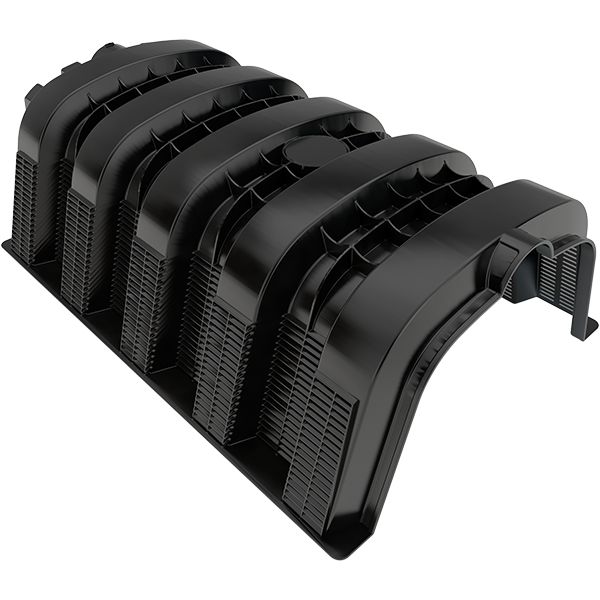
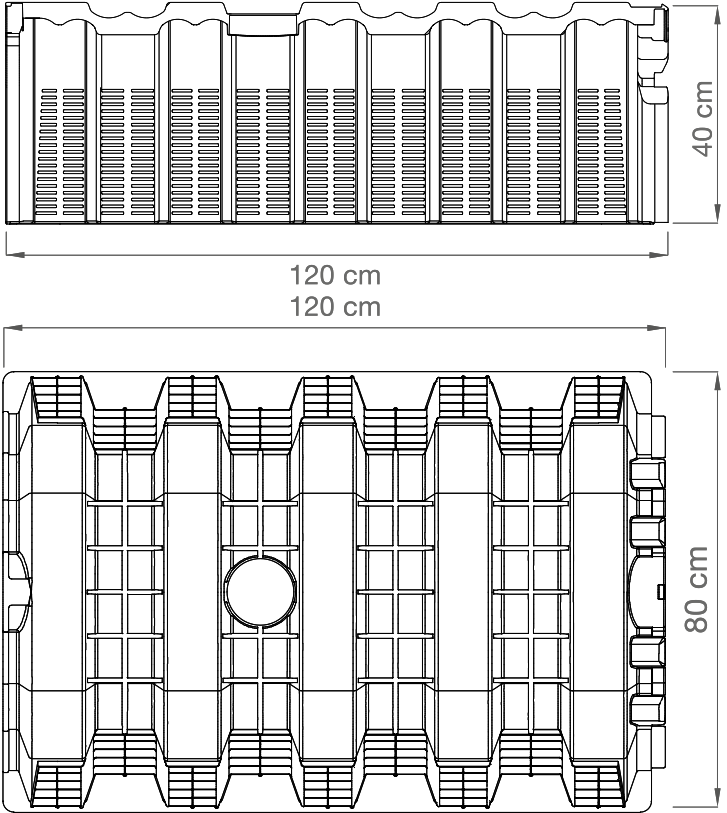
DRENING |
| Dimensions (cm) | 120 x 80 x H40 |
| Length once installed (cm) | 117 |
| Material | Graplene (Recycled Polypropylene Compound) |
| Volume (I) | 310 |
| Lateral infiltration surface (cm2) | 2.800 |
| Package size (cm) | 120 x83 x H245 |
| No. units per pallet | 40 |
| Product code | EDRENPP0040 |
|
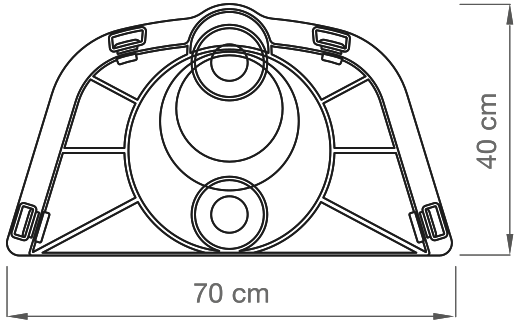
DRENING CAP |
| Dimensions (cm) | 70 x 40 |
| Thickness | 6 |
| Material | Graplene (Recycled Polypropylene Compound) |
| No. units per pallet | 100* |
| Product code | ETAPDPP0040 |
| * Each palet of Drening can contain up to 10 pcs. Drening cap | |
Installation
- The following directions are necessary to obtain a correct place:
- Ground excavation at the right depth. The depth has to be calculated on the strenght of a technical and geology specialized study;
- Place of a base of gravel with a proper thickness that it’s necessary to give a great level of stability defined by the underground soil;
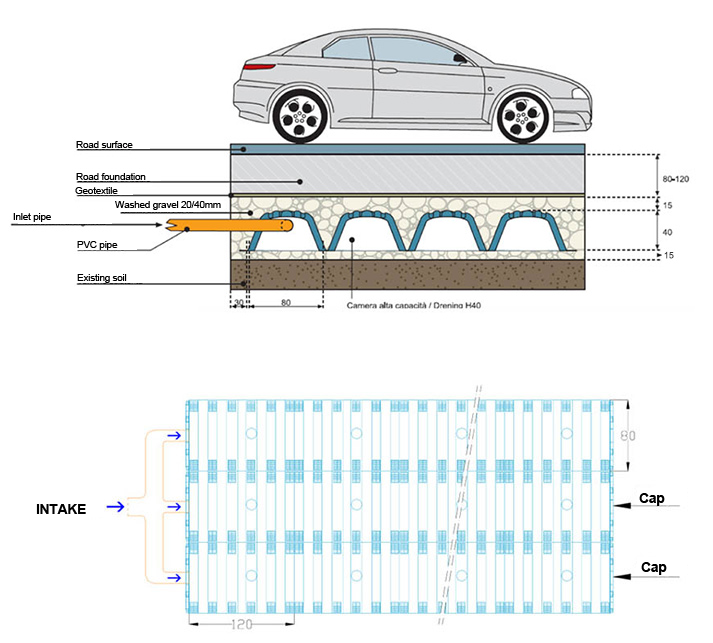
- Place the needed quantity of DRENING in order to develop the requested basin. The size of the basin is determined by the morphological analysis of the area;
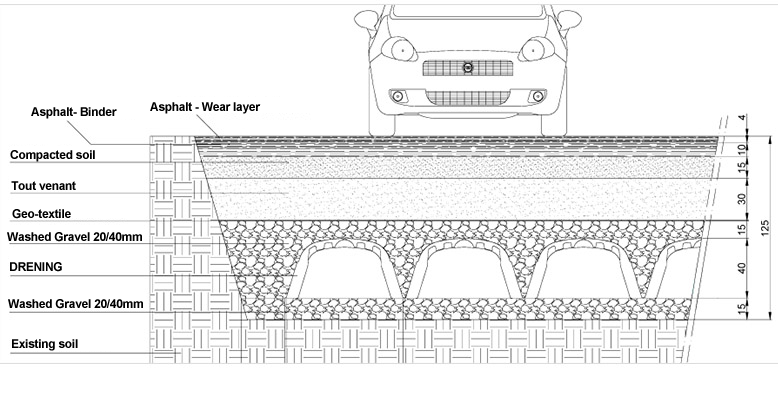
- Covering of the DRENING with gravel, from a minimum of 15 cm;
- Insertion of a no woven fabric in the gravel layer. This is necessary to stop any impurity from the obstruction of the side holes during the draining.
- Full coverage of the work
Laying base
Drening can be placed over different types of surface. The dig-depth depends on ground stability, root zone, insertion systems levels and estimated water discharges that is the the existence or depth of the aquifer. Over the excavation a gravel bed have to be placed, its minimum thickness of 10 cm. The gravel have to be washed in order to avoid fine particles that may obstruct the insertion in the basin bottom.The gravel can be of river derivation, or crushed stones, grain size 20-40 mm, in order to avoid the obstruction of Drening® chambers side holes by smaller stones. The layer of grave on the base aims to the sabilization of Drening bed place to create a draining layer and help the insertion. In fact it have to be consolidated through rolling or mechanical compactor. Estimated accumulation gravel capability is of 30% of its volume. However, the designer and the applicant company are the ones in charge of the load capability and of the excavation base insertion capability. Then, before the system designing, a geotechnical survey of the Drening placing area is also needed. it is recommended a prediction of a 0.1% slope in the direction of the basin’s end. Soft grounds with a load capability lower than 96 kPa need the valuation of a geologist to adopt a specific solution. An increase of the gravel placing bed thickness is also recommended in order to increase the foundation’s load capability. Finally, the place of a non-woven fabric or of a thermoplastic net with a knitting lower than 20×20 cm between the placing bed and the Drening base is needed.
Drening chambers place
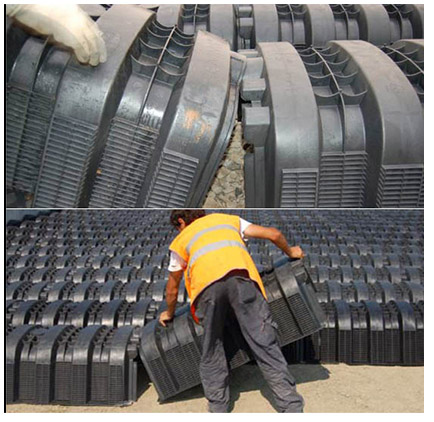
Drening chambers place have to be made completely by hand. For a correct place, the Drening chamber have to be linked in longitudinal direction to the ground chamber placing it at 30° in respect to the placing bed and hooking it from top to bottom. In the cross-direction, Drening chambers have to be simply pull near one another without hooks, leaving a 10 cm gap between the mid rib base of the further elements.
Drening chambers backfill
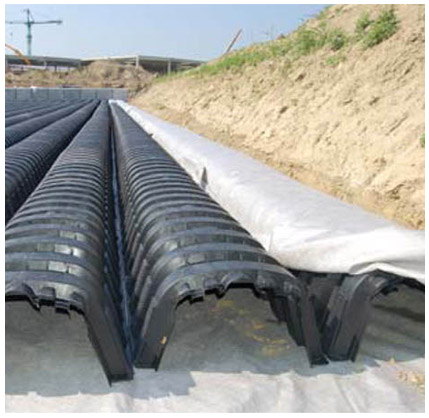
The first thing to do, after the place of the Drening element, is fill the gap between the excavation, the perimetral chamber and the interstice between the across combined chambers. During this stage is forbidden to climb into the chambers with any mechanical means. Moreover, the place of a geo-textile strip for the containment of the excavation’s sides along all the dig perimetral, is recommended. The geo-textile have to be placed under at least 3 Drening and then put on top of the separation geo-textile.
Drening chambers covering
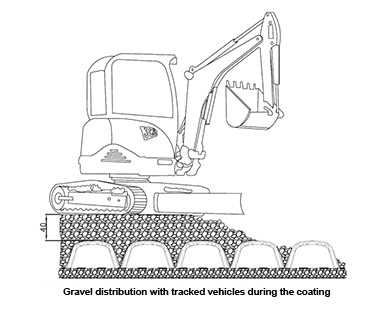
After the backfill, the next step is the covering of Drening chambers, with a minimum thickness of 15 cm of washed gravel to avoid the fine particles that may obstruct the seepage at the bottom of the basin. The gravel can be of river derivation or crushed stones, grain size 20-40 mm, in order to avoid the obstruction of Drening chambers side holes by the smaller stones. During this stage, only the climb into the chambers with medium tonnage track vehicles is allowed and the gravel thickness between the Drening top and the caterpillar base must be of 40 cm. The costumer is in charge of the observance of load limitations. Geoplast S.p.A is not liable for incoveniences caused by the use of overburden no-track vehicles with gravel thickness lower than 40 cm. An entry angle of the mean equal to 45° in respect to the basin axis is recommended in order to enter into the basin with mechanicals means during all the gravel filling operations and to avoid the move of Drening chambers. The entry angle is also important to avoid the climbing perpendicularly and laterally to the caps moving the no-consolidate gravel.
Placing stages
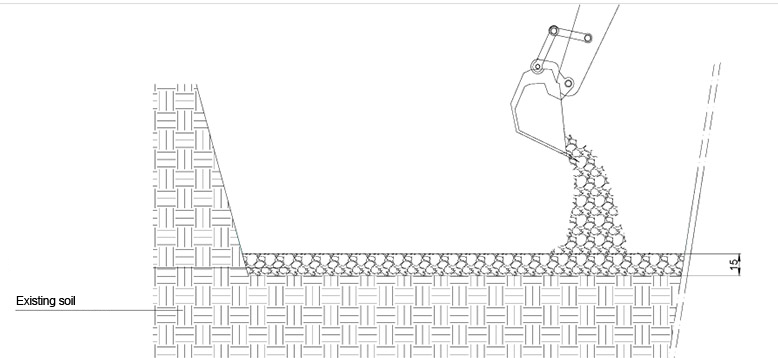
1ST STAGE
Ground excavation.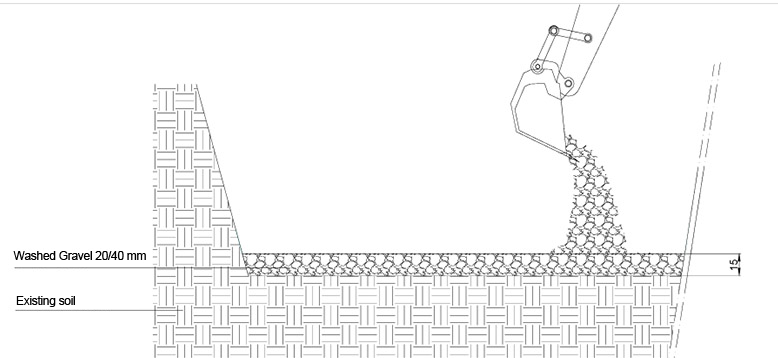
2ND STAGE
Laying of the washed gravel and later compaction.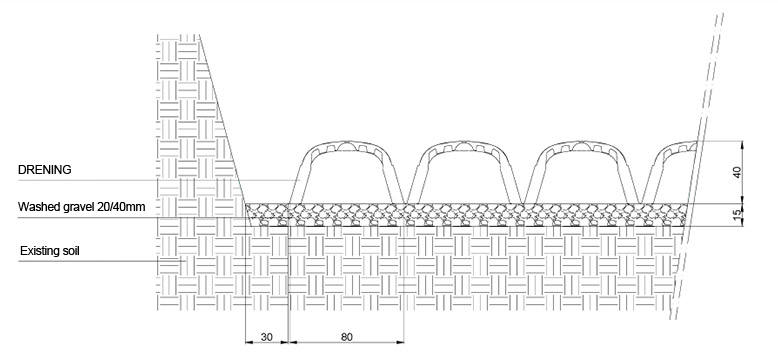
3RD STAGE
DRENING chambers placing, leaving a 30 cm gap beween the excavation edge and the chambers all over the perimeter. DRENING have to be lenghtwise hooked but simply place side by side crosswise.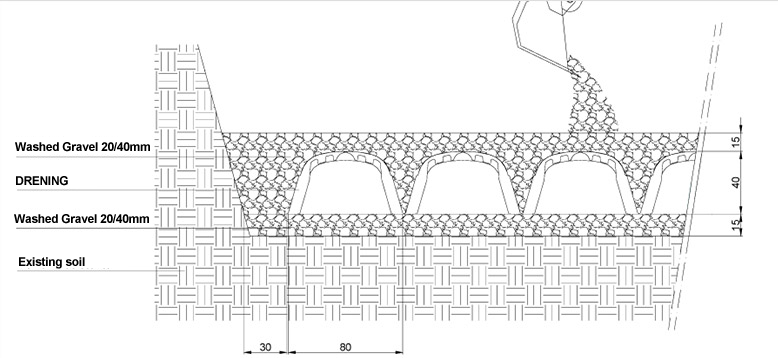
4TH STAGE
Covering with washed gravel at the required thickness.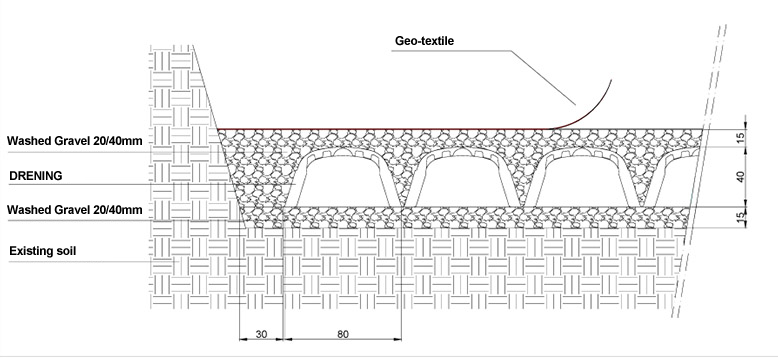
5TH STAGE
Laying of the non-woven fabric.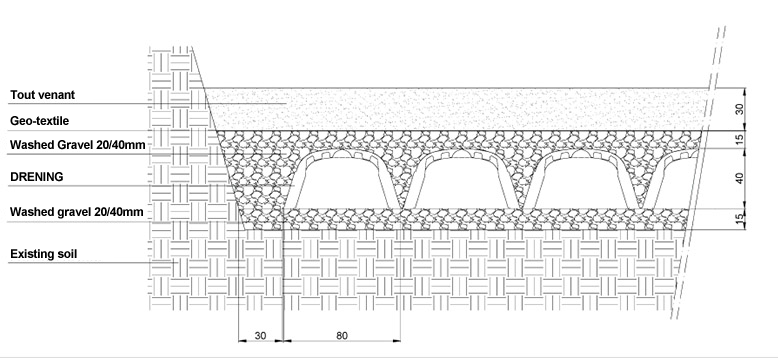
6TH STAGE
Realization of the load share road base at the required thickness.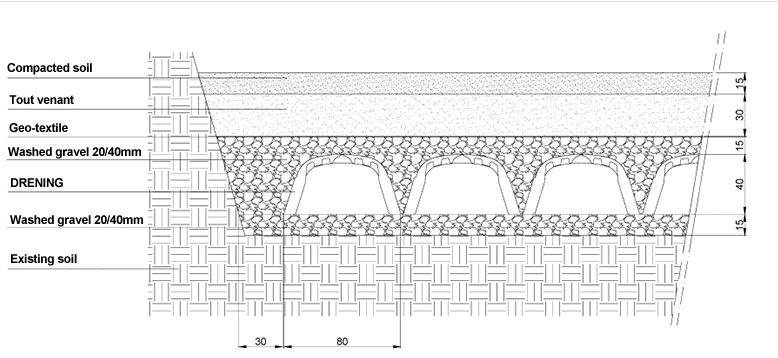
7TH STAGE
Realization of the road base flattened and compacted.